
Nightstand Wood Joints: The Complete Guide to Strong & Durable Joinery
Discover how dovetail, mortise & tenon, dowel, and other wood joints affect the strength, longevity, and value of your nightstand. Learn what to look for before you buy.
Explore Joint TypesWhy Wood Joints Matter More Than You Think
The joinery used in a nightstand determines whether it will wobble after a year or remain solid for decades. A beautiful finish can hide poor construction, but the joints tell the real story. Understanding nightstand wood joints empowers you to judge quality beyond the showroom shine — and to avoid expensive mistakes. Whether you are browsing nightstand materials or comparing nightstand types, joinery is the invisible factor that separates heirloom-quality furniture from disposable flat-pack pieces.
What Are Wood Joints in Nightstand Construction?
Wood joints are the methods used to connect two or more pieces of wood together. In a nightstand, joints appear at every critical connection point: the corners of the carcass (the main body), the drawer boxes, the legs and aprons, and any decorative elements. The type of joint used directly impacts structural integrity, load-bearing capacity, and resistance to racking — the twisting and wobbling that occurs when a nightstand is pushed or pulled across a floor.
Cheap nightstands often rely on staples, nails, and simple butt joints reinforced with glue. Premium pieces use interlocking joinery that mechanically locks wood pieces together, often without relying solely on adhesive. When you are shopping for a nightstand, knowing the joinery helps you evaluate whether the price reflects genuine craftsmanship or just marketing.
The 7 Most Common Nightstand Wood Joints Explained
Below are the joinery methods you will encounter most often in nightstand construction, ranked roughly from strongest and most desirable to weakest and least durable.
1. Dovetail Joint
Excellent Strength Premium QualityThe dovetail joint is the gold standard for drawer construction. Interlocking wedge-shaped tails and pins create a mechanical lock that resists pulling apart. When you pull a drawer open, the dovetail actually gets tighter rather than loosening. This is why high-end two-drawer nightstands and three-drawer nightstands almost always feature dovetail drawer boxes.
Where You Will Find It
- Drawer corners (front and back)
- Occasionally on carcass corners in premium furniture
- High-end walnut and oak nightstands
Pros
- Exceptional mechanical strength — no glue required to hold
- Withstands decades of daily opening and closing
- Visually signals quality craftsmanship
- Resists pulling apart under load
Cons
- Expensive to produce — requires skilled labor or precision machinery
- Rarely found in budget furniture
- Hand-cut dovetails add significant cost
Verdict: If you see dovetail joints, you are looking at a quality piece. Compare with dovetail vs stapled drawers to understand the full contrast.
2. Mortise and Tenon Joint
Excellent Strength Heirloom QualityThe mortise and tenon is one of the oldest and strongest joints in woodworking. A rectangular projection (the tenon) fits into a matching cavity (the mortise). When glued, the long grain surfaces create a bond that is often stronger than the wood itself. This joint is commonly used for attaching legs to aprons and for frame construction.
Where You Will Find It
- Leg-to-apron connections
- Frame-and-panel construction
- High-end mid-century and traditional nightstands
Pros
- Extremely strong and durable
- Provides excellent resistance to racking
- Can be pinned with dowels for extra security
- Timeless, proven construction method
Cons
- Labor-intensive to produce
- Requires precise cutting for a tight fit
- More expensive than simple alternatives
Verdict: A hallmark of quality furniture. When combined with proper nightstand leg styles, it creates a rock-solid foundation.
3. Dowel Joint
Good Strength Common in Mid-RangeDowel joints use cylindrical wooden pins (dowels) to align and reinforce connections between two pieces of wood. They are common in mid-range furniture and flat-pack designs because they are faster and cheaper to produce than mortise and tenon. When properly glued and fitted, dowel joints can be quite strong, though they lack the mechanical interlock of dovetails.
Where You Will Find It
- Carcass assembly
- Leg attachment
- Edge-to-edge panel joins
- Many engineered wood nightstands
Pros
- Stronger than butt joints or nails
- Relatively inexpensive to produce
- Good alignment — dowels keep pieces from shifting during glue-up
- Widely used and well-understood
Cons
- Not as strong as dovetail or mortise and tenon
- Can loosen over time if glue fails
- No mechanical interlock — relies heavily on adhesive
Verdict: Acceptable for budget and mid-range pieces. If a nightstand uses dowels throughout, it can still be a solid buy — just not an heirloom.
4. Box Joint (Finger Joint)
Good Strength Decorative AppealThe box joint, also called a finger joint, uses interlocking rectangular cuts. It is simpler to produce than a dovetail but offers similar mechanical strength because the interlocking fingers resist pulling apart. Box joints are often used in drawer construction as a more affordable alternative to dovetails.
Where You Will Find It
- Drawer boxes
- Decorative carcass corners
- Some rustic nightstands where the visible joint is part of the aesthetic
Pros
- Strong mechanical interlock
- Easier to produce than dovetails
- Visually interesting when left exposed
- Good compromise between cost and quality
Cons
- Not as strong as a true dovetail
- Less common in high-end furniture
- Can be imitated by cheaper finger-jointed lumber (which is different and weaker)
Verdict: A solid choice for drawer boxes in mid-range nightstands. Better than stapled or nailed construction.
5. Rabbet and Dado Joints
Good Strength Common in Cabinet WorkA rabbet is a step cut along the edge of a board, while a dado is a groove cut across the grain. These joints are used to create strong, square connections in cabinet and nightstand construction. A dado joint supports shelves and dividers, while a rabbet is often used for back panels and drawer bottoms.
Where You Will Find It
- Shelf supports
- Back panel attachment
- Drawer bottom insertion
- Cabinet-style combination storage nightstands
Pros
- Provides excellent support and alignment
- Increases glue surface area
- Resists twisting and racking
- Standard in quality cabinet construction
Cons
- Requires precise cutting
- Not a standalone joint — usually combined with glue and fasteners
- Can weaken the board if cut too deep
Verdict: A sign of thoughtful construction. When you see dados supporting shelves in an open-shelf nightstand, that is a good indicator of quality.
6. Butt Joint
Moderate Strength Budget ConstructionThe butt joint is the simplest wood joint: two pieces of wood are joined end-to-end or edge-to-edge without any interlocking features. Strength comes entirely from glue, nails, screws, or brackets. While easy and cheap, butt joints are the weakest option and are common in budget furniture.
Where You Will Find It
- Budget nightstands
- Flat-pack furniture
- Hidden internal connections
- Some affordable nightstand picks
Pros
- Simple and fast to produce
- Inexpensive
- Acceptable when reinforced with screws, brackets, or dowels
Cons
- Weakest joint type
- Relies entirely on fasteners and glue
- Prone to loosening and separation over time
- Not suitable for load-bearing applications without reinforcement
Verdict: Avoid nightstands held together primarily by butt joints and staples. If you must buy budget, look for reinforced butt joints with screws and brackets.
7. Stapled or Nailed Joint
Low Strength Disposable QualityStaples and nails are fasteners, not true wood joints. They are used in the cheapest furniture to hold pieces together long enough to be sold. A stapled drawer or carcass will typically loosen within a year or two of normal use. If you see visible staples or nails at stress points, consider it a warning sign.
Where You Will Find It
- Very cheap nightstands
- Furniture meant to be disposable
- Internal connections hidden from view
Pros
- Extremely fast and cheap to assemble
- Keeps production costs low
Cons
- Poor structural integrity
- Loosens quickly with use
- Difficult to repair effectively
- Not a sign of quality craftsmanship
Verdict: Avoid if possible. For a full comparison, read dovetail vs stapled drawers to see the dramatic difference in durability.
Wood Joint Comparison Table
Use this quick-reference table to compare the most common nightstand wood joints at a glance.
| Joint Type | Strength | Cost | Common Use | Durability |
|---|---|---|---|---|
| Dovetail | Excellent | High | Drawer corners | 50+ years |
| Mortise & Tenon | Excellent | High | Legs, frames | 50+ years |
| Box Joint | Good | Medium | Drawer boxes | 20–30 years |
| Dowel | Good | Low–Medium | Carcass, legs | 10–20 years |
| Rabbet & Dado | Good | Medium | Shelves, backs | 20–30 years |
| Butt Joint | Moderate | Low | Budget furniture | 3–10 years |
| Stapled / Nailed | Low | Very Low | Cheap furniture | 1–5 years |
What Wood Joint Quality Means for Nightstand Pricing
Joinery is one of the biggest factors in nightstand pricing. Here is what you can generally expect at different price points:
- $50–$150: Stapled or nailed construction, butt joints, particleboard. Expect to replace within a few years. See affordable nightstand picks for the best options in this range.
- $150–$400: Dowel joints, some rabbet and dado construction, engineered wood or mixed materials. Decent for guest rooms or temporary use.
- $400–$1,000: Box joints in drawers, dowel and dado carcass construction, solid wood components. Good everyday durability.
- $1,000–$2,500: Dovetail drawers, mortise and tenon legs, solid hardwood throughout. Heirloom quality that lasts decades.
- $2,500+: Hand-cut dovetails, traditional joinery, premium hardwoods, artisan craftsmanship. Investment furniture.
When browsing mid-range nightstand picks or high-end nightstand collections, always ask about joinery. It is the single best indicator of whether the price is justified.
How to Inspect Nightstand Wood Joints Before Buying
Whether shopping online or in person, these inspection tips will help you evaluate joinery quality:
In Person
- Open the drawers. Look at the drawer box corners. Dovetails are unmistakable — interlocking wedge shapes. Box joints look like interlocking fingers. Staples look like, well, staples.
- Wiggle the nightstand. A well-jointed piece will feel solid. If it twists or wobbles, the joints are weak.
- Check the underside. Look for screws, brackets, and corner blocks. These are often used to reinforce weaker joints.
- Look at the back panel. A rabbeted or dadoed back panel indicates quality. A stapled-on cardboard back indicates budget construction.
- Inspect the legs. Legs attached with mortise and tenon or heavy-duty bolts will be rock solid. Legs attached with a single screw will loosen.
Online
- Read the product description carefully. Look for terms like "dovetail construction," "mortise and tenon," "English dovetail," or "box joint."
- Check customer reviews. Look for complaints about wobbling, drawers sticking, or joints loosening.
- Look at close-up photos. Many listings show drawer corner details. Zoom in.
- Avoid vague language. If a listing says "sturdy construction" without specifying joinery, assume it is basic.
Maintaining and Repairing Wood Joints
Even the best joints can loosen over time. Here is how to keep them tight:
- Control humidity. Wood expands and contracts with moisture changes. Keep your bedroom between 40–50% relative humidity. See moisture protection for nightstands.
- Avoid dragging. Always lift and carry your nightstand rather than dragging it, which stresses joints.
- Tighten hardware. Periodically check and tighten screws, bolts, and brackets. See nightstand screw types for guidance.
- Use wood glue for repairs. If a joint loosens, wood glue (not nails) is the proper fix. See nightstand drawer repair for step-by-step instructions.
- Address wobbles immediately. A wobbly nightstand puts stress on all joints. Fix it early with nightstand leveling.
Ready to Find a Nightstand with Quality Joinery?
Browse our curated recommendations for nightstands built with durable, long-lasting wood joints.
View Recommended NightstandsRecommended Nightstands with Quality Wood Joints
⚠️ AFFILIATE DISCLOSURE: This website contains affiliate links. As an affiliate Associate, we earn from qualifying purchases. If you make a purchase through these links, we may receive a small commission at no additional cost to you. Read our full affiliate policy.

AWASEN Nightstand, Mid Century Modern Night Stand with Drawer for Living Room, Modern Bedside End Table with Spindle Wood Legs for Bedroom, Office, Rustic Brown
Check price on Amazon
Solid Walnut Wooden Storage Box with Lid – Desk Organizer for Small Items | 7.08" x 4.72" x 1.88", Dovetail Corner Joints, Open Top Tray Design, Desk & Nightstand Use, Natural Wood Grain
Check price on Amazon
23.63" 2 Drawers Solid Wood Nightstand, Natural Oak Bedside Table | Solid Red Oak with mortise & tenon joints, smooth wood slides — small mid century modern night stand for bedside or sofa.
Check price on Amazon
HomeStock Upmarket Cappuccino Nightstand, 3-Drawer, Real Wood Veneers, Dovetail Joints, Nickel Hardware, Fully Assembled, Perfect for Any Bedside
Check price on Amazon
Furniway Mid Century Walnut Nightstand with 2 Drawers, Modern Wooden Bedside Table with Hidden Handles and Solid Wood Legs for Bedroom
Check price on Amazon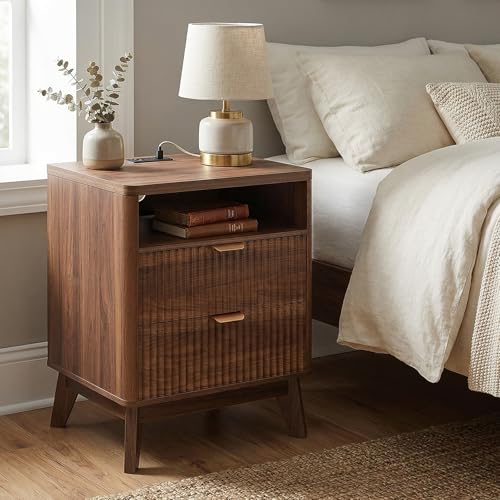
LYNCOHOME Fluted Nightstand with Charging Station, 19.7 inch Wide End Table with 2 Drawers, Modern Wood Bedside Table for Bedroom,Brown,1 Pcs
Check price on Amazon
Yoobure Modern Nightstand with Drawer, Bedside Tables, Mid Century Nightstands with Open Storage Shelf, Wood Bedside Table, Small Night Stands for Bedrooms, 2-Tier Night Table
Check price on AmazonFrequently Asked Questions About Nightstand Wood Joints
Final Thoughts: Why Joinery Should Guide Your Purchase
Wood joints are the skeleton of your nightstand. They determine whether it will hold your books, lamp, and morning coffee reliably for years — or wobble and creak within months. When you understand joinery, you gain the ability to look past surface finishes and marketing language to judge true quality.
As you continue your research, explore our nightstand material hub to understand how wood species affect joint performance, and check our care and maintenance guides to keep your joints tight for decades. For a complete buying framework, start with our first nightstand checklist and avoid common nightstand buying mistakes.
Whether you choose a modern, rustic, or minimalist design, insist on quality joinery. It is the difference between furniture you own and furniture you replace.