
Getting Started with Nightstands: Your Beginner's Guide
Everything you need to know before buying your first nightstand — from measuring your space to choosing the right style, size, and features.
START YOUR JOURNEYWelcome to NightstandHub! If you're new to buying furniture — or just new to nightstands — this page is designed for you. We'll walk you through every step of the process, from understanding what a nightstand actually does to making your final purchase decision. No jargon, no pressure, just clear, practical advice.
What Is a Nightstand and Why Does It Matter?
A nightstand — also called a bedside table or night table — is a small piece of furniture placed next to your bed. Its primary purpose is to hold items you need within arm's reach while you're in bed: a lamp, a book, your phone, a glass of water, medication, or reading glasses.
But a nightstand is more than just a surface. It's a functional anchor for your bedtime routine and a design element that ties your bedroom together. The right nightstand makes your bedroom feel more organized, more comfortable, and more intentional. The wrong one — too big, too small, wrong height — creates daily frustration.
If you're just beginning your search, we recommend starting with our Nightstand Starter Hub, which collects all our beginner-friendly resources in one place. From there, this page will guide you through the essential first steps.
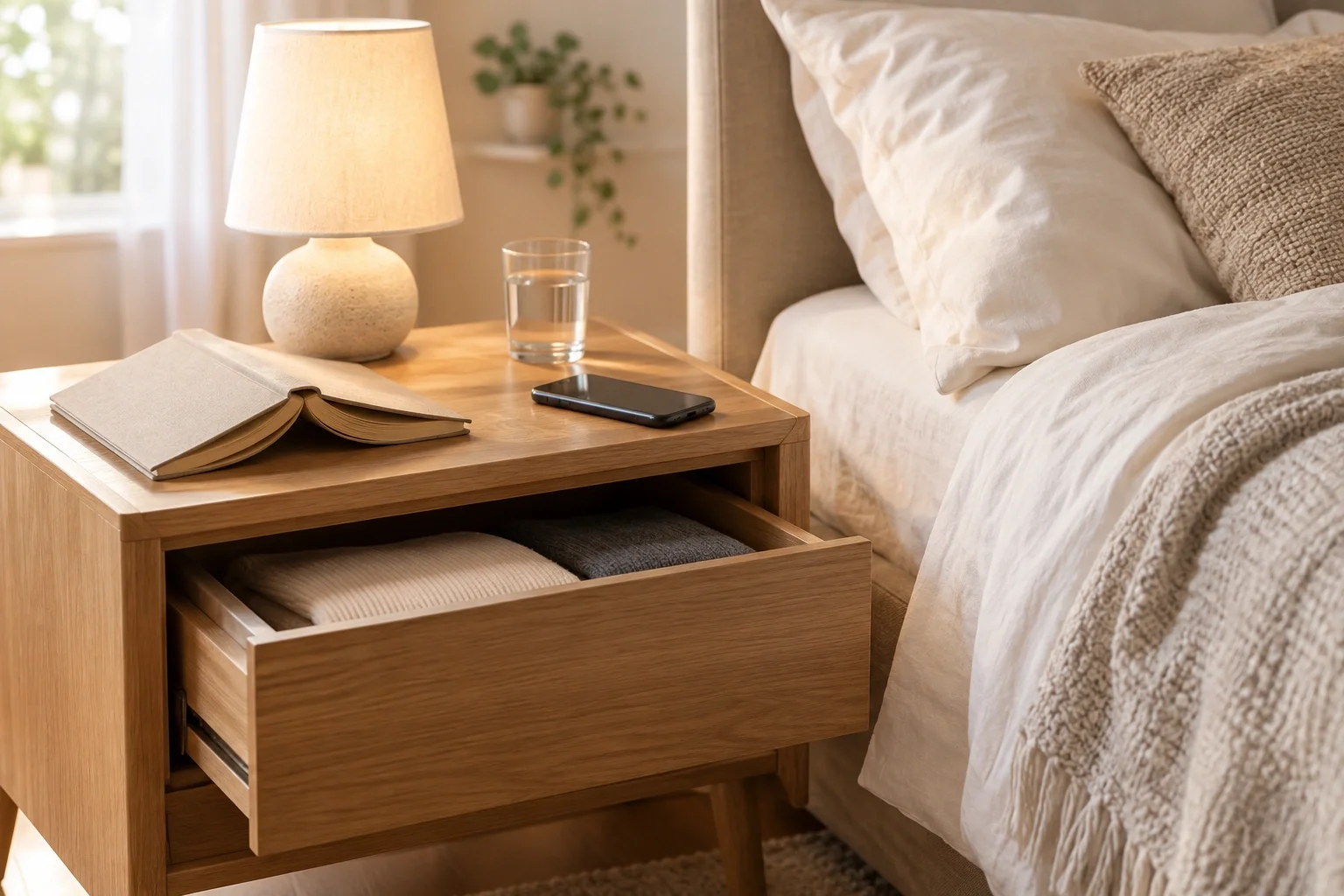
Measure Your Space Before You Shop
This is the single most important step, and it's the one most first-time buyers skip. Before you look at a single product, grab a tape measure and record the following:
Space Measurement Checklist
- Available width — the horizontal space between your bed and the nearest wall or furniture
- Available depth — how far the nightstand can extend into the room without blocking walkways
- Bed height — measure from the floor to the top of your mattress
- Wall space — if considering a floating nightstand, check for studs and clearance
- Door and drawer clearance — make sure drawers can open fully without hitting anything
A general rule: your nightstand should be roughly the same height as your mattress, or within 2–4 inches of it. This keeps items within easy reach. If your bed is unusually high or low, look at tall nightstands or adjust your expectations accordingly. For more detailed guidance, our nightstand dimension chart breaks down standard sizes by bed type.
Pro Tip: Use painter's tape to mark the footprint of your ideal nightstand on the floor. This gives you a real sense of how much space it will occupy before you buy.
Decide What You Need to Store
Think about what you actually keep at your bedside. Be honest — this determines your storage configuration more than anything else.
- Just a phone and a lamp? A single-drawer nightstand or open shelf nightstand is enough.
- Books, chargers, glasses, medication? A two-drawer nightstand keeps everything hidden and organized.
- A lot of items or shared use? Consider a three-drawer nightstand or a combination storage nightstand.
- Need charging? Look at nightstands with charging stations or USB ports.
Once you know what you need to store, choosing between drawer configurations becomes much easier. If you're unsure, our guide on open vs closed storage explains the trade-offs in detail.
Choose Your Style and Material
Style is personal, but material affects durability, maintenance, and value tier. Here's a quick overview of what to expect:
For a deeper dive into materials — solid wood, veneer, metal, rattan, and more — visit our Material & Finish Hub. If you already know you want wood, our oak nightstand guide and walnut nightstand guide are great starting points.
Set a Realistic Value Tier
Nightstands range from budget-friendly to luxury. Here's what you can expect at each tier in today's market:
Nightstand Value Tiers
- Budget-friendly: basic materials, simple construction, often flat-packed
- Mid-range: solid wood or quality engineered wood, better hardware, more design options
- Premium: solid hardwood, soft-close drawers, premium finishes
- Luxury: designer brands, exotic materials, handcrafted details
Don't forget to factor in accessories. A bedside table lamp, organizer inserts, and non-slip pads will shift your total to the next tier if you're not careful. Our affordable nightstand picks and mid-range picks guides can help you find the best value at each tier.
Check Quality Before You Buy
Not all nightstands are built equally. Even at the same value tier, quality can vary significantly. Look for these indicators of good construction:
Quality Checklist
- Dovetail joints on drawers — much stronger than stapled or glued joints. See our dovetail vs stapled drawers guide.
- Soft-close hardware — prevents slamming and extends drawer life. Learn more in our soft-close drawer guide.
- Solid wood or high-quality engineered wood — avoid particle board that crumbles over time. Our solid wood vs veneer guide explains the difference.
- Sturdy legs and joinery — check our leg styles guide and wood joints guide for what to look for.
- Anti-tip hardware included — essential for safety, especially in homes with children or pets. See anti-tip straps.
If you're buying online, read reviews carefully and look for close-up photos of joints and hardware. If buying in person, open and close the drawers, feel the weight, and check for wobbles.
Common Beginner Mistakes to Avoid
Avoid These First-Time Buyer Errors
- Buying before measuring — the most common mistake. Always measure first.
- Ignoring bed height — a nightstand that's too low or too high is uncomfortable every day.
- Choosing style over function — a beautiful nightstand with no storage is still frustrating.
- Forgetting about assembly — some nightstands require significant assembly. Check our assembly guide first.
- Skipping anti-tip installation — especially important for tall nightstands and homes with kids.
- Not planning for cable management — chargers and lamps create clutter fast. See cable management.
For a more detailed breakdown, read our full guide on nightstand buying mistakes.
Best Nightstands for Beginners
⚠️ AFFILIATE DISCLOSURE: This website contains affiliate links. As an affiliate Associate, we earn from qualifying purchases. If you make a purchase through these links, we may receive a small commission at no additional cost to you. Read our full affiliate policy.

Furologee Night Stand with Charging Station, 2 Fabric Drawers, White | Night Stand with USB & Outlets, Side Table with Storage & Hooks, Industrial End Table for Living Room/Bedroom
Check price on Amazon
BOLUO White Nightstand with Charging Station, LED Night Stand with 2 Fabric Drawers, Bedside Table with USB Ports and Outlets, Nightstand for Bedroom Modern
Check price on Amazon
Yoobure Nightstand with Charging Station, Small Night Stand with Fabric Drawers and Storage Shelf for Bedrooms, Small Spaces, Bedside Table with USB Ports & Outlets
Check price on Amazon
SUPERJARE Nightstand with Charging Station, USB-C Port, Bedside Table | Night Stand for Bedroom, with Adjustable Fabric Drawer, 3-Tier Storage, Industrial End Table, Rustic Brown & Black
Check price on Amazon
OLIXIS Nightstand with Charging Station, Beside Table with Fabric Drawer | 3-Tier End Table with 2 Storage Shelves,Night Stand with USB Ports and Outlets for Bedroom, Black and Rust
Check price on Amazon
DUMOS Nightstand with 2 Fabric Drawers, Small Bedside Table for Bedroom | 2 Drawers Fabric Storage Chest, Fabric Bedside Storage Furniture for Closet, Bedroom, White
Check price on Amazon
WLIVE Night Stand, Small Dresser with 2 Drawers & Wooden Top, Nightstand with Fabric Bins, Bedside Table End Table for Bedroom, Closet, Entryway, College Dorm, Rustic Brown
Check price on Amazon
VASAGLE Side Table, Small End Table, Tall Nightstand, Steel Frame | For Living Room, Bedroom, Office, Bathroom, Rustic Brown and Ink Black ULET273B01
Check price on AmazonYour Next Steps
Now that you understand the basics, here's where to go next:
Frequently Asked Questions for Beginners
For a first nightstand, the mid-range tier strikes a reasonable balance between quality and value. At this tier, you can find solid wood or quality engineered wood with decent hardware. If you're furnishing a guest room or a temporary setup, a budget-friendly tier can work well. Check our affordable nightstand picks for recommendations at every tier.
It depends on your bed size and room layout. A queen or king bed in a shared bedroom usually benefits from two nightstands for symmetry and convenience. In a small bedroom or single-occupancy room, one nightstand is often enough. If space is tight, consider a floating nightstand on one side or a corner nightstand to save floor space.
The top of your nightstand should be within 2–4 inches of your mattress top. This makes it comfortable to reach for items without stretching or bending. Measure your bed height before shopping, and if you have an unusually high bed, look at tall nightstands. Our dimension chart has standard heights by bed type.
It varies. Flat-packed nightstands from budget-friendly brands typically require 30–60 minutes of assembly. Higher-tier and solid wood nightstands often come mostly assembled. Before buying, check the product description for assembly requirements. Our nightstand assembly guide covers tools you'll need and tips for faster assembly, and our screw types guide explains common hardware.
Basic care goes a long way. Dust regularly, wipe spills immediately, and use coasters under drinks. For wood nightstands, apply a sealant or wax periodically. Our Care & Maintenance Hub covers surface cleaning, scratch touch-ups, water ring removal, and long-term protection. Start with our surface cleaning guide for daily care.
You're Ready! Buying your first nightstand doesn't have to be overwhelming. Measure your space, decide what you need to store, pick a style you love, choose a value tier that fits your needs, and check the quality before you commit. If you follow those five steps, you'll end up with a nightstand that serves you well for years. When you're ready to browse, our Shopping & Reviews Hub has curated recommendations for every room and value tier.